
You Don’t Need a Brain to Have a Mind
What if intelligence did not begin with brains, but with life itself?
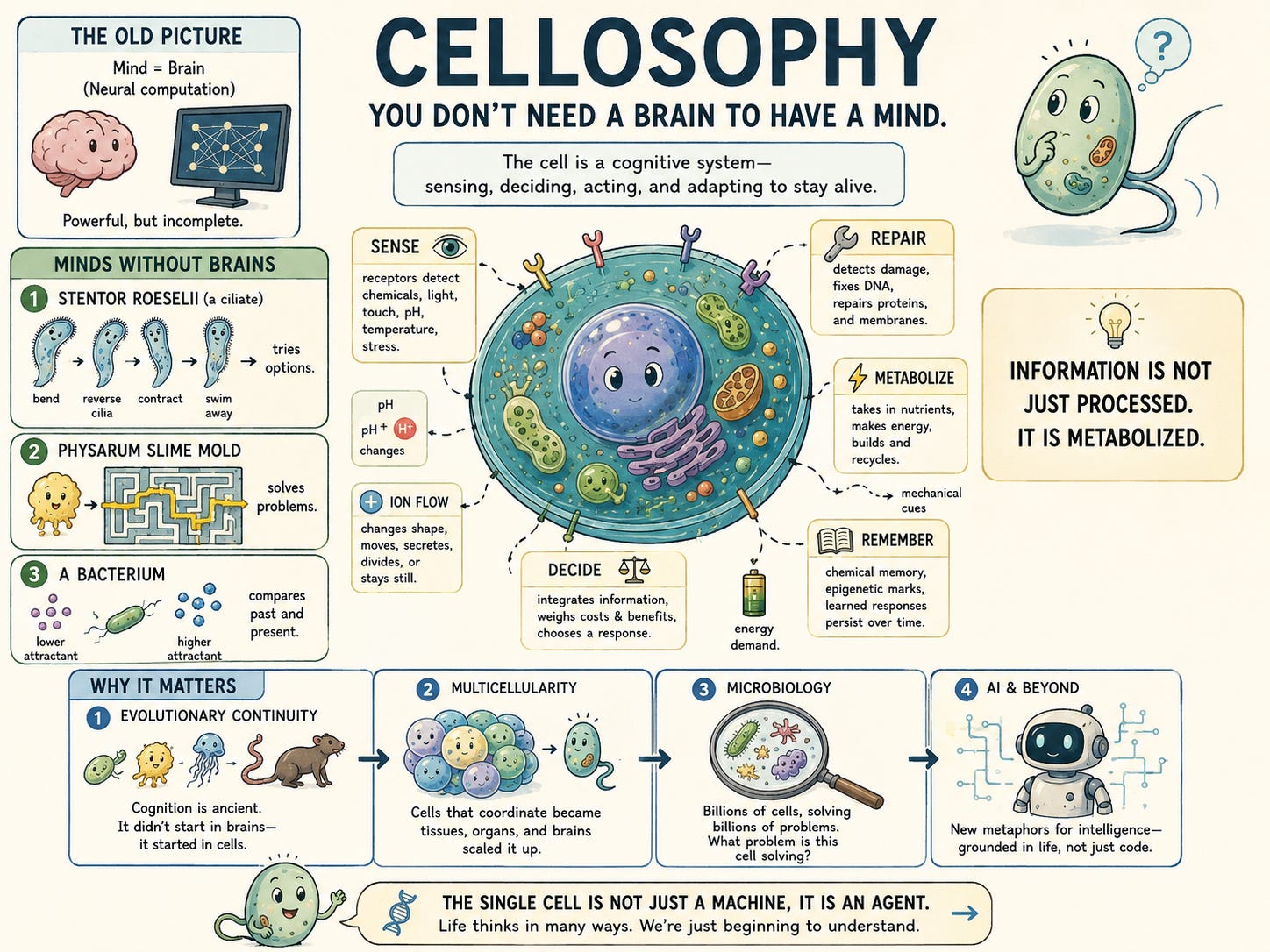
Cellosophy explores a radical scientific possibility: that single cells may already possess the basic ingredients of cognition. Bacteria remember chemical conditions. Slime molds solve problems without nervous systems. Individual cells sense, evaluate, repair, adapt, and act in uncertain environments. By looking closely at life at the cellular scale, we ask where mind begins, how intelligence evolved, and what cellular cognition might teach us about biology, artificial intelligence, and ourselves.
Discover minds without brains. Meet ciliates, bacteria, slime molds, and other organisms whose behavior challenges familiar ideas about memory, learning, and decision-making.
See life from the cell’s point of view. Explore a world where sensing, metabolism, survival, and action are inseparable—and where information is not merely processed, but metabolized.
Follow a new scientific adventure. Cellosophy connects microbiology, evolution, cognitive science, philosophy, and AI to uncover new questions about the origins and varieties of intelligence.
Subscribe to Cellosophy
Join us as we explore the strange, beautiful possibility that intelligence is as ancient as life itself. Subscribe for essays, discoveries, experiments, and ideas from the emerging frontier of cellular cognition.
